Quick Summary: Repairing bowing basement walls in Maryland typically costs between $500 and $1,000 per carbon fiber strap for minor inward movement (less than 2 inches), and $1,500 to $2,500+ per steel I-beam for severe deflection or wall shear (greater than 2 inches). While carbon fiber offers a low-profile, non-invasive fix, structural steel beams provide the heavy-duty resistance needed to stabilize and potentially push back severely failing foundation walls.
If you have noticed horizontal cracks spreading across your cinder block foundation or basement walls that appear to be leaning inward, your home is sending an urgent warning sign. Inwardly bowing basement walls are a primary indicator of severe foundation distress in Maryland and Northern Virginia homes. Left untreated, soil pressure will continue to push foundation masonry inward until structural integrity fails completely, leading to costly floor joist disconnection, ceiling sagging, or localized wall collapse.
Choosing the correct stabilization method depends on the degree of deflection, wall material, and long-term repair goals. This guide breaks down why basement walls bow, compares the two industry-standard structural repair solutions—Carbon Fiber Straps and Steel I-Beams—and outlines average installation costs across the Mid-Atlantic region.
What Causes Basement Walls to Bow Inward in Maryland?
The primary culprit behind bowing foundation walls throughout Maryland is hydrostatic pressure created by expansive soil conditions. Mid-Atlantic soils contain high concentrations of heavy clay. During wet seasons, clay soil absorbs large volumes of rainwater, swelling significantly and exerting immense lateral force against subterranean masonry walls.
When this lateral earth pressure exceeds the load-bearing capacity of concrete block or poured concrete, the wall begins to shear and deflect inward. Common factors accelerating hydrostatic pressure include:
- Improper Yard Grading: Rainwater pooling around the perimeter foundation backfill zone instead of sloping away.
- Clogged or Short Downspouts: Gutter discharge dumping roof runoff within 3 feet of foundation walls.
- Freeze-Thaw Cycles: Saturated soils freezing during winter, pushing inward against block joints.
- Root Expansion: Large tree roots growing close to basement walls, displacing soil and adding physical pressure.
Option 1: Carbon Fiber Strap Reinforcement
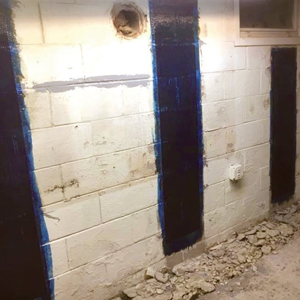
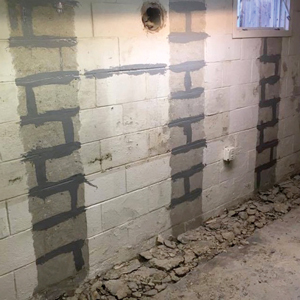
Carbon fiber wall reinforcement represents modern aerospace engineering applied to residential foundation repair. Carbon fiber straps are woven fabric strips impregnated with high-tensile carbon strands bonded directly to the foundation face using structural epoxy resin.
How Carbon Fiber Straps Work
Installers grind the wall paint and efflorescence down to bare concrete, apply a high-strength epoxy tie-in anchor at the top plate, and secure the bottom to the concrete slab. Once cured, carbon fiber is virtually unbreakable, exhibiting a tensile strength up to 10 times stronger than steel.
When to Choose Carbon Fiber
- Minor Deflection: Ideal for walls with less than 2 inches of total inward bowing or tilt.
- Zero Space Loss: Straps are ultra-thin (roughly 1/16th of an inch thick), laying flush against the wall.
- Paintable Finish: The cured straps can be primed, painted, or framed over with drywall without losing interior square footage.
- Non-Corrosive: Carbon fiber never rusts, degrades, or requires mechanical adjustment.
Option 2: Structural Steel I-Beam Installation
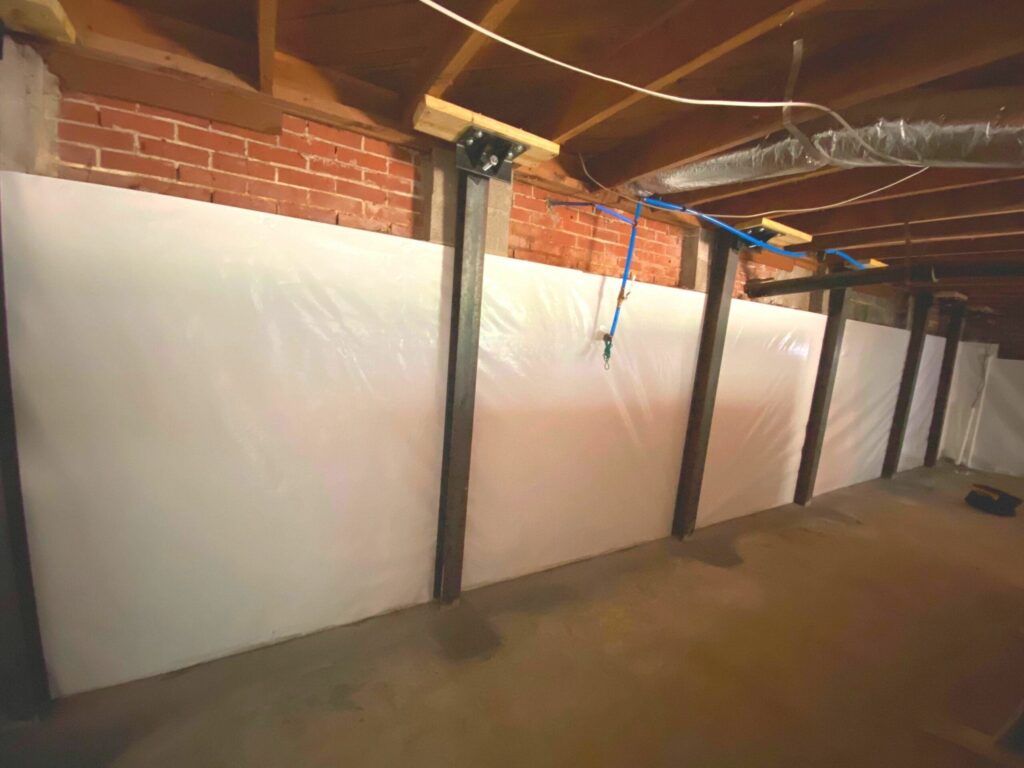
Steel I-beam reinforcement (often called steel wall braces) is the traditional, heavy-duty solution for severe foundation failure. Heavy-gauge structural steel columns are positioned vertically against the wall at precise intervals.
How Steel I-Beams Work
Each steel beam is secured to the concrete floor slab at the base and bolted to the floor joists overhead using custom structural brackets. The beam acts as a rigid brace that transfers lateral earth pressure directly into the floor system above and below, preventing further inward wall movement.
When to Choose Steel I-Beams
- Severe Deflection: Required when walls bow more than 2 to 3 inches inward.
- Shear Movement: Necessary when the top or bottom course of block has sheared off the floor joists or slab.
- Push-Back Potential: Heavy steel beams can be equipped with torque screws to gradually press bowed walls back toward plumb over time during dry seasons.
Cost Comparison: Carbon Fiber vs. Steel I-Beams (2026 Price Guide)
Foundation repair costs depend heavily on the length of the damaged wall, access considerations, and the total number of braces or straps needed (typically spaced every 4 to 5 feet along the wall run).
| Feature / Metric | Carbon Fiber Straps | Steel I-Beams |
|---|---|---|
| Average Cost Per Unit | $500 – $1,000 per strap | $1,500 – $2,500+ per beam |
| Average Full Job Total | $4,000 – $8,000 (4-8 straps) | $8,000 – $18,000+ (5-8 beams) |
| Max Bow Allowance | Up to 2 inches | 3+ inches (severely bowed) |
| Intrusiveness | Low (flush to wall, clean) | Moderate (protrudes 4–6 inches) |
| Wall Straightening | Stabilizes only (no push-back) | Can tighten to push wall back |
| Warranty Coverage | Lifetime Transferable | Lifetime Transferable |
Frequently Asked Questions
Can bowing basement walls cause a home to collapse?
Yes. Left unchecked, lateral earth pressure will push bowing walls past their structural center of gravity. As the wall moves inward, floor joists lose their bearing support, which can cause floor sagging above, ceiling cracking, frame twisting, and eventual structural collapse of the foundation wall.
Does homeowners insurance cover foundation wall bowing?
Standard homeowners insurance policies generally exclude damage caused by hydrostatic pressure, earth movement, or naturally accumulating groundwater. Because bowing walls develop gradually over time, insurance adjusters classify this as maintenance or earth movement rather than sudden accidental loss.
How long do carbon fiber wall straps last?
Carbon fiber wall stabilization is a permanent structural repair. When properly bonded with commercial-grade epoxy resin and anchored to the rim joist and floor slab, carbon fiber does not stretch, rust, rot, or lose tension over time. Most reputable foundation repair contractors back carbon fiber systems with lifetime transferable warranties.
Protect Your Home’s Structural Safety Today
If you suspect your basement walls are bowing or horizontal cracks are widening, early intervention can save thousands in extensive masonry reconstruction. Contact Armored Basement Waterproofing today at (443) 949-3180 to schedule a comprehensive, non-commissioned structural inspection and receive a transparent, written repair estimate.